


Published: March 23rd, 2016
Moderator:
Ruslan Grinberg, Co-chairman of the Moscow Economic Forum, scientific director of the Institute of Economics
Speakers:
Dominique Strauss-Kahn, Managing Director of the International Monetary Fund from 2007 to 2011
Sergey Arbuzov, Chairman of the Association “Research Center of economic, social and cultural development of the CIS, Central and Eastern Europe”
Alexander Auzan, the dean of the Faculty of Economics of Moscow State University
Yuri Boldyrev, Member of the Editorial Board of the Russian business magazine, economist, writer
Vladislav Zhukovsky, economist, trade expert
Grzegorz Kolodko, Professor of Kozminsky University, Minister of Finance of Poland (1994–1997, 2002–2003)
Alexander Nekipelov, RAS Academician, Director of the Moscow School of Economics of Moscow State University
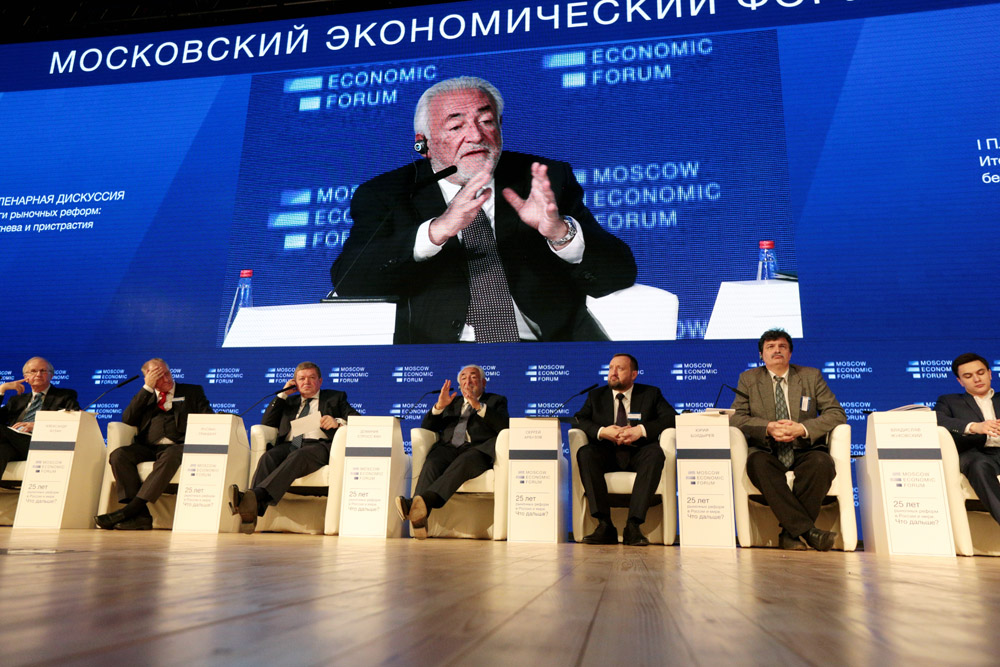
March 23, 2016 in Moscow, in Moscow State University Lomonosov, in the framework of the Moscow Economic Forum a plenary discussion: "The results of the market reforms without anger and bias" has been held. Participants from 47 regions of Russia and 16 countries gathered to take stock of 25 years of the transformation of the former socialist camp. The moderator of the discussion was co-chair of the Forum, scientific director of the Institute of Economics RAS Ruslan Grinberg.
His view on the transformation of the Russian economy expressed the Dean of the Economic Faculty of Moscow State University Alexander Auzan. According to him, it was not the transition to market-democratic system, but quite a successful transit of the shortage economy to a consumer society, which ended approximately in 2007-2008. However, the initial estimation on the fact that the market will put everything in places, led to the formation of extractive institutions, blocking the further development of the economy.
"If you have these or other resistance forces, the uneven distribution of wealth automatically balance does not happen, there are no automatic efficiency wins", - says Alexander Auzan. Therefore, it is certain that the formed consumer society based on extractive institutions is not conducive to the development - it is a certain impasse from which we must go. "Could you, solving the problem of satiety, return to long-term development goals? In my opinion, this is the main task for today ", - said the economist.
Our understanding of the essence of transition to a market economy were primitive - it was stated by Alexander Nekipelov, Academician, Director of the Moscow School of Economics of Moscow State University. "We have attached special importance to the process of liberalization of economic activities and thus did not realize the importance of the issue of the formation of the agents that are adequate to the market economy. Roughly speaking, we have came to and had during the 1990s an amazing situation where we are largely liberalized all economic activities, but for many years appeared to be in captivity of the unprecedented problems of non-payment", - the expert MEF noted.
He told of the standard methods of the economic policy leading to the different results than it should have led in the circumstances of the market. The misunderstanding of the importance of the problem of creating the economic subjects of the market-driven economy, wrong positioning of the resources, the shock0therapy concept and gradualism led to a very costly mistakes.
"We have lost the main part of the hi-end manufacture, by deciding to make the transformation in the shock-mode by any means necessary. It was accompanied by many conflicts, impoverishment of the nation, many contradictions. This fact itself took toll on our political system. If we had decided to make the reforms in this mode we had to power up the authoritarian tendencies. Unfortunately, it still manifest today”, - finished Nekipelov.
Sergei Arbuzov Chairman of the Association “Research Center of economic, social and cultural development of the CIS, Central and Eastern Europe” while talking on the results of the Ukranian economical transformation told that that country have the only one path to salvation – to resume the relations with Russia and CIS.
In his speech the famous Ukrainian politician drew a parallel between two epochs in Ukraine: the post-soviet when the young nation still had the backlog, left from the soviet period, and today. “In year 1991 there were the same perspectives in Russia and Ukraine: the countries made there first steps in the market-driven economy, had good results in agrarian sector, industry”, noted the speaker. However Ukraine could not realize those plans. More so, the country can not reach the results of 1991.
Sergei Arbuzov thinks that there are several reasons for negative economical development dynamics. The government could ensure only 18% while the other 80% were provided by the allies. It means that the country was not ready for entering the market. The miracle did not happen.
Analyzing the Ukrainian economy of the last two years, it is seen that in this period it had lost more that for the latest two decades of the independence. The abrupt change of the way-mark for the West led to seizing the trade relations with Russia and CIS, - stated Sergei Arbuzov, - because of that Ukrain had lost more than 10 billion dollars.”
The situation is the developing in such way, - noted the speaker, - that now Ukraine has to borrow those gigantic, unbearable for the feeble economy sums from IMF. The results of those changes were indicators, which collapsed completely: GDP minus 15%, 40% inflation, a catastrophic impoverishment of the population - the average wage is less than $ 50.
Ukraine are getting itself deeper into the dept by fulfilling the requirements of the IMF, Sergei Arbuzov thinks. That is why today, the expert thinks, there is only one exit – the renewal of the relations with the Russian Federation, the return of the lion's share of exports to Russia.
Grzegorz Kolodko, Professor of Kozminsky University, Minister of Finance of Poland noted that Poland hurried to the market-driven economy tha same way as Russia. The key to the successful development of the market has become the principle of an isosceles triangle whose sides are important values, social institutions, and implement policies. It is needed to improve the policy for effective and productive functioning of the institutions.
Kolodko underlined that 25 years ago Russian GDP was way higher than Chinese, but now it is vise versa – Chinese GDP exceeds Russian 6 times. “The thing is that the Chinese knew from the beginning the way they were heading. They went to a market economy as it currently exists in China. Therefore, we do not need a planned economy, but need the strategic thought. To successfully develop and produce visible results Russia must select a competent strategy of economic development ", - concluded the scientist. In Poland, this strategy was based on the theory developed by the new pragmatism.
On the results of the reforms occurred in 90 his views expressed Yuri Boldyrev, a member of the Russian Editorial Board, economist, publicist. In the modern sense of market reforms - is, above all, the inclusion of market mechanisms for the growth of the national economy. "The processes that occurred in our country in the recent past, allegedly in order to increase competition have been tampered with destructive model, parasitizing on natural resources, purposefully destroying the fabric of life, society and the state", - said the economist. This model arose to freely sell the national wealth and to buy other goods with the money. Boldyrev said that he had repeatedly warned of the decline in demand for raw materials. And now the drop in oil prices is a serious call for Russia. According to expert, this trend is a real chance to reflect and concentrate all efforts on the formation of creative development model of society, state and economy.
Diversification of the economy - it is a strategy that Russia should adopt, said the famous French politician and economist, former director of the International Monetary Fund Dominique Strauss-Kahn, noting that the problem of Russian economy is resources export-oriented, which does not work in today's conditions.
"The West, IMF included, tried to participate in the process of transformation of the Soviet Union and help to come on the way of the market-driven economy, - said Strauss-Kahn. - But we do not fully understand by which rules it works. Economy - is not physics, it's people, culture, history. And you can not just borrow the political elements, institutions so that they have successfully taken root anywhere."
Economics provides some information, but real life is more complicated than theoretical research. The EU was not simple and there is no other model of functioning, except for the market. And managing it is an extremely difficult question, because economic theory - it is not the laws of physics. And, perhaps, the Europeans attempted to promote their way of life in other cultures is one of the factors of failure, the politician suggested.
According to the economist, the country needs to develop a strategy for economic development and adapt its public resources. So far, Russia has not done enough to move away from the raw scheme of financing the economy. Expensive oil has deprived the state incentive to increase productivity, to develop other sectors of the economy. Now in Russia there is no other way but to develop small and medium business, because the Russian economy is mostly held in large enterprises. You need to sell not only oil and gas but also other kinds of goods for the international market, the expert said. If you do not develop other sectors of the economy, not invest in science and not use human capital, Russia may remain trapped in low-income, summed up Strauss-Kahn.
Economist Vladislav Zhukovsky urged not to make a choice between the bottom and the "Black Square" by Malevich - the two systems, one of which was in a state of destruction, degradation and decomposition, and the second did not become a constructive creative alternative. The expert noted the anti-social and destructive nature of the Russian reforms, when in Russia a "chimera" was created , which incorporates the negative traits of the market, and the Soviet economy. "That what had happened is difficult to call Reform. Most likely, it was the epitome of clan interests of individuals who wanted to redistribute certain state assets into their own hands, and extremely illegitimate and illegal, "- said Vladislav Zhukovsky.
The participant of the plenary discussion mentioned that the quasi-market and pseudo-liberal character of the changes cited to the appearance of the economic model in which virtually no private property, and any development prospects outside the commodity sector, and entrepreneurs are perceived as "cash cows" as used in the interests of a parasitic power.
This parasitic model considers Zhukovsky, focused only on the decumulation of production and technological safety margin left over from the Soviet economy, natural resource rents and human capital. Today's economy is characterized by a disregard for human interests, the absence of a competitive market and corruption, the economist said.
"In our economy only those who are either sitting on the oil pipe or scrolls dollars in our financial system, earns" - Zhukovsky said. Getting rid of the current economic Russia will trap only the change of the political course, the center of which should be in the national interests of both social and labor of the majority, and small businesses, to overcome dependence on natural resources and human development, the MEF-expert concluded.
At the end of the plenary discussion of its moderator, co-chairman of the Moscow Economic Forum, scientific director of the Institute of Economics Academy of Sciences Ruslan Grinberg argued that on formal grounds Russia - the market and the private economy on earth, and for the successful development it is necessary to develop mega-projects with a multiplier effect. The speaker also said that one of the incentives for the country's development would be the introduction of a progressive tax scale.
Ruslan Grinberg called on the audience in the hall not to forget about its citizenship: "We will have elections, and we are obliged to show our civic responsibility, we must turn from subjects into citizens, we still have enough democratic space for that."
Source: PR department of MEF
Latest news
07.05.2018 MEF-2018: debate "Cultural policy: between individual freedom and the interests of society?"
07.05.2018 MEF-2018: Conference No. 8
07.05.2018 MEF-2018: Conference No. 4
07.05.2018 MEF-2018: Conference No.3
07.05.2018 MEF-2018: Conference No. 2
07.05.2018 MEF-2018: Conference No.1
26.04.2018 McConnell Discusses Information Warfare
20.04.2018 MEF-2018: closing plenary session
17.04.2018 Mr. Freysinger: «Skripal’s case» for relationship between Russia und European Union?